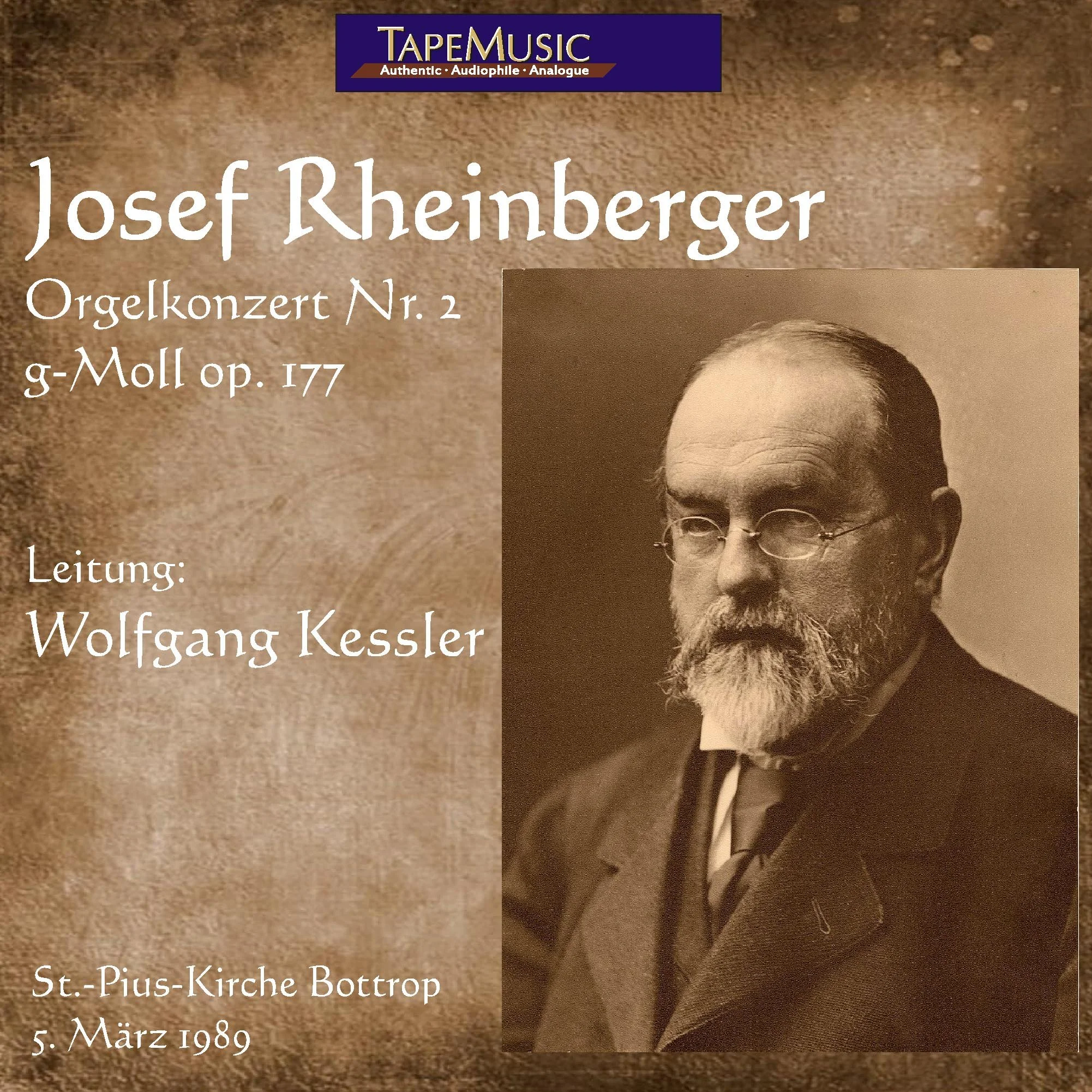

Josef Rheinberger
Orgelkonzert Nr. 2 g-Moll op. 177
Publisher: RN Audio
Playing time: 27 min
Specifications: half track ¼“, stereo, RTM SM 900, 514 nWb/m, CCIR, 38 cm/s
Reel(s): 1 standard metal reel, printed, with sticker
Packaging: 1 standard cardboard box, with stickers, with spine labeling
Inserts: 1 insert sheet, 1 booklet with 5 pages
Homepage: https://www.tapemusic.eu/
Author: Claus Müller
Recording organs and orchestras is Rainer Neuwirth’s (RN Audio) specialty. That’s why I was thrilled when he announced that he would be releasing this analog recording from 1989 as a master tape copy. I opted for the largest version: RTM SM900 tape at 38 cm/s with a level of 514 nWb/m. With this level, the studio tape operates at its optimal point just below the distortion threshold. The rich sound is a joy to listen to because it fully brings out the cherished qualities of the magnetic medium. The price for this master tape copy is very reasonable. The version I tested costs 294.00 EUR. Please contact RN Audio for other versions or special requests.
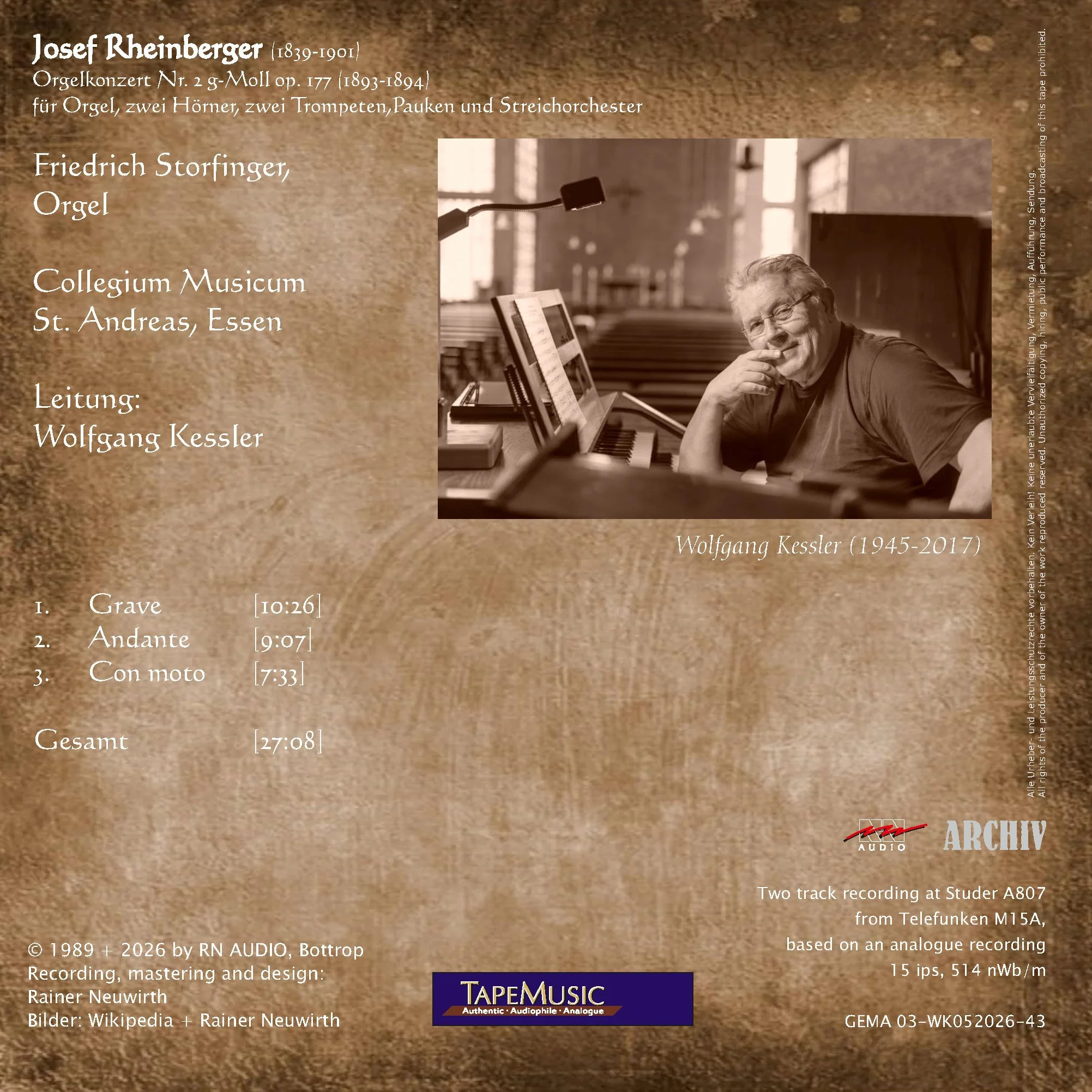
The concert at St.-Pius-Kirche in Bottrop (Germany) was conducted by Wolfgang Kessler. Friedrich Storfinger played the organ. The Collegium Musikum St. Andreas Essen served as orchestra. The five-page booklet provides detailed information about the concert and the composer Josef Gabriel Rheinberger.
Josef Rheinberger was born in Vaduz (Principality of Liechtenstein) in 1839 and worked in Munich (Germany) throughout his life. He composed a rich body of work. The Organ Concerto No. 2 in G minor, Op. 177, is typical of his compositional style. It is one of his most mature works, composed in 1893–94 and published in 1894. With its combination of late-Romantic sonority, classical formal discipline, and contrapuntal artistry, it clearly reveals Rheinberger’s compositional style. Unlike many Romantic concertos, Rheinberger does not feature the organ as a prominent soloist but rather as an equal partner to the orchestra.
In the first movement, “Grave,” we hear a call-and-response between the organ and the orchestra. As the movement progresses, the composer develops a remarkably densely woven movement, characterized by a constant dialogue between the orchestra and the organ. Musical themes are introduced by the strings, taken up by the organ, and further developed. Rheinberger masterfully manages to interweave lyrical passages with dramatic scenes.
The second movement, “Andante,” serves as the concert’s anchor of tranquility. The music maintains a lyrical character throughout, and its melodic beauty evokes the Romantic tradition of Schumann and Brahms. The calm opening mood gives way to a lively middle section. The musical expression intensifies until tranquility returns toward the end.
Striking chords and rhythmic impulses open the third and final movement, “Con moto,” bringing energy back to the work. Thematic richness and musical contrasts are interwoven. The organ is played with virtuosity, yet remains closely connected to the orchestra, leading it to a powerful and triumphant finale.
I was instantly captivated by the appeal of the combination of sonic opulence, melodic warmth, and technical precision. The work stands as a significant example of late-Romantic organ music. For me, this master tape copy - which is very well balanced sonically - is a magnificent discovery that I highly recommend to all tape enthusiasts.
Translated from German with www.DeepL.com (free version)
The entire content and the individual elements of the web page are the intellectual property of Claus Müller and are subject to copyright protection. They may not be copied or imitated in whole or in part by the user; this applies to texts, logos and image components. Any modification, duplication, distribution or reproduction of the website or parts thereof, in any form whatsoever, is not permitted without the prior written consent of Claus Müller.
Der gesamte Inhalt und die einzelnen Elemente dieser Webseite sind geistiges Eigentum von Claus Müller und unterliegen dem Schutz des Urheberrechts. Sie dürfen vom Nutzer weder kopiert noch im Ganzen oder in Teilen imitiert werden; dies gilt insbesondere für Texte, Logos und Bildbestandteile. Jegliche Veränderung, Vervielfältigung, Verbreitung oder Wiedergabe der Webseite sowie Teilen hiervon, gleich welcher Art, ist ohne vorherige schriftliche Zustimmung von Claus Müller nicht zulässig.